Introduction
On April 23, 2026, the AI sector saw several significant advancements. From open-source large language models to updates to commercial products, and from video generation to music creation, technological innovation continues to push the boundaries of application.
DeepSeek-V3 Officially Open-Sourced
According to an official announcement from DeepSeek, the DeepSeek-V3 model was officially open-sourced today. The model has demonstrated outstanding performance across multiple benchmarks, particularly in code generation and mathematical reasoning tasks. The open-source license allows research institutions and commercial companies to use the model free of charge, provided they comply with the terms. This is expected to lower the barrier to entry for AI application development, impacting AI startups and researchers alike.
Google Releases Gemini 2.0 Pro
Google announced today the launch of Gemini 2.0 Pro. According to the Google AI Blog, the new version features significant improvements in multimodal understanding and long-context processing capabilities, supporting more complex instruction-following and creative tasks. This update is primarily aimed at enterprise customers and developers and may intensify competition with companies like OpenAI in the enterprise AI market.
New Breakthroughs in AI Video Generation Technology
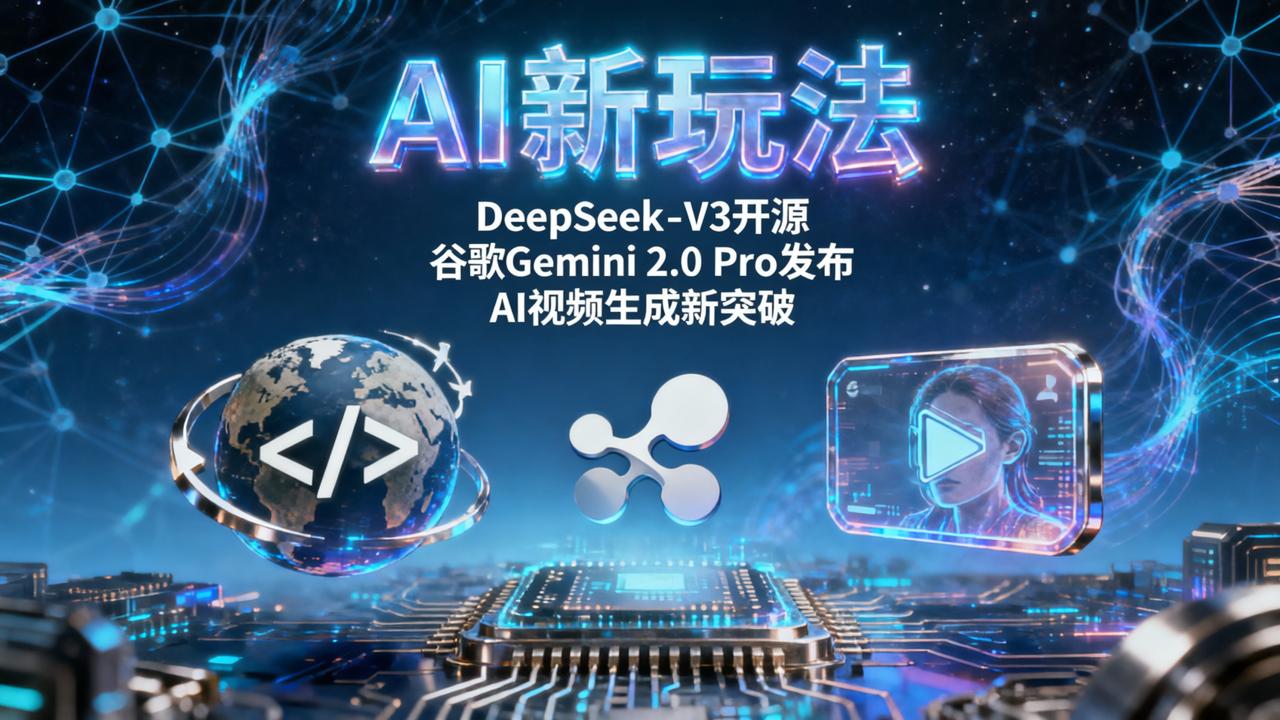
A startup has demonstrated its new AI video generation model. According to TechCrunch, the model has made progress in the coherence and physical plausibility of generated videos. Although not yet publicly released, the demo results show enhanced AI capabilities in understanding dynamic scenes, which could impact video content creation, advertising, and the entertainment industry.
Updates to AI Music Creation Tools
A popular AI music generation tool has released a major update. According to an announcement on its official website, the new version introduces more refined style controls and collaboration features, allowing musicians to engage more deeply in the creative process. This marks a shift for AI from being a replacement tool to a collaborative partner, with independent musicians and producers as its primary users.
AI Code Generator Efficiency Boost
GitHub revealed in a blog post that the latest iteration of its AI programming assistant, Copilot, has improved in the accuracy of code suggestions and contextual understanding. By more efficiently leveraging developers’ programming context, it aims to reduce iteration time, directly impacting the daily workflows of software engineers.
Summary and Outlook
Today’s developments highlight two major trends in AI: first, the capabilities of top-tier models are continuing to deepen at both ends of the spectrum—toward generalization and specialization; second, AI tools are becoming more user-friendly and collaborative, integrating more deeply into specific workflows. The parallel development of open-source and closed-source approaches is accelerating the technological diffusion and application innovation across the entire ecosystem. In the coming months, it will be crucial to monitor the practical implementation of these technologies and the evolution of their business models.